Distillation Lab

A distillation simulator for batch stills and continuous plants

See inside your still.

Distillation Lab runs a still plate by plate: the temperature, strength and flows on every plate, the heads and the fusel oil, every jar you cut. Try cuts, columns and settings, and see how distillation works, before you heat a drop of wash.

  • 0–50bubble-cap plates, or a packed bed
  • 6congeners followed from mash to jar
  • ≈ 0.3 Kfrom published ethanol–water boiling data
  • 1× – 1000×run speed, rewind to any moment

Tour

One run, every angle.

Every view follows the same run as it happens. Switch between them at any moment; pause, and they all show the same instant.

3D lab. Cut the column open and look at the plates boil: the liquid on each is coloured by its temperature, strength or congeners, and froths while vapor bubbles through. Turn it, zoom, and click the heater, a valve or the condenser to see how it runs and change its settings.
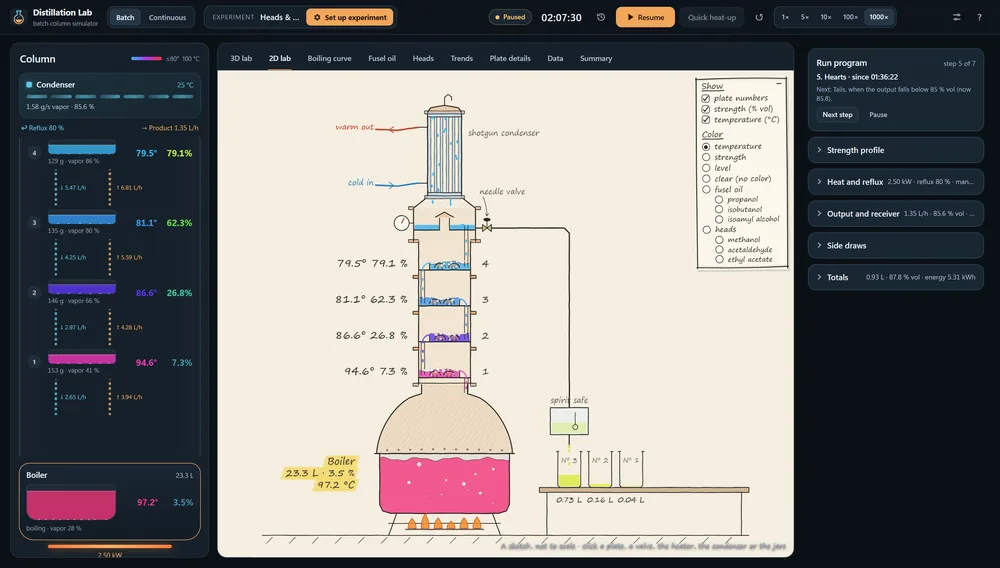
2D cutaway. The same still as a sketch: the liquid on each plate and its bubbles, the downcomers, condensate dripping onto the collecting plate, the reflux and the product running into the jar. Colour it by temperature, strength, level or congener.
Setup. A guide in seven steps: recipe, apparatus, mash and boiler, column, heat and cooling, reflux and stop, review. Every field knows the range the model accepts and says so before you start.

Design

Build a still, plate by plate.

Start from a pot still, up to 50 bubble-cap plates, or a packed bed of Pro-Pak, Dixon rings, copper mesh or ceramic rings and saddles. Pick a boiler from 30 to 3,000 litres, a heater, a condenser and the head.

The plate designer draws one plate to scale as you type: its diameter, the weir's height and crest and the downcomer, with a drinks can beside it for size, and tells you how much liquid it holds and how long its downcomer takes to pass it on.
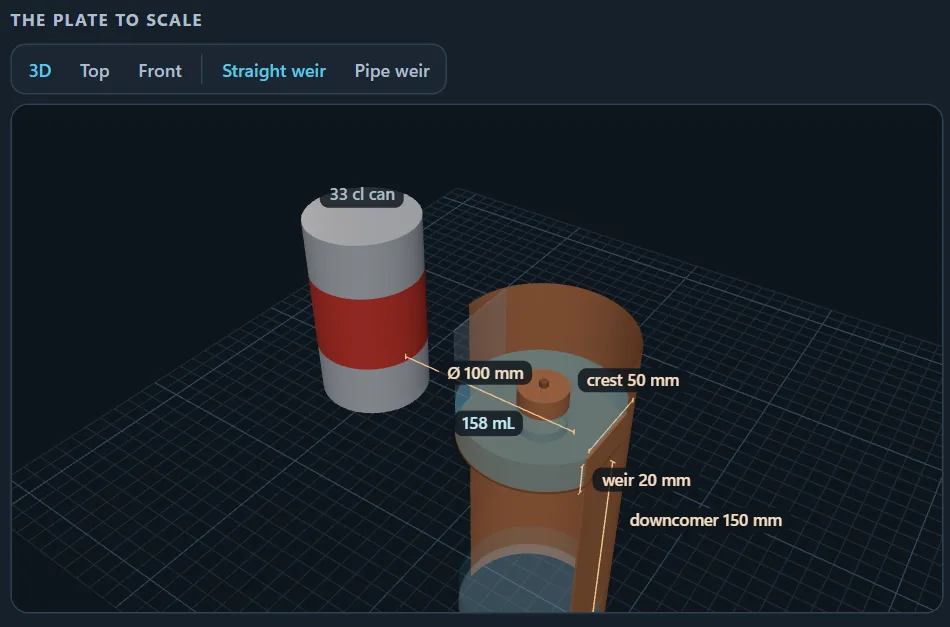
The plate designer: a 100 mm plate in 3D with its weir, crest and downcomer dimensioned beside a 33 cl can, and the plate's facts.

Congeners

Know where the heads and the fusel oil go.

Charge a sugar wash, rye, plum, cider, red wine, a malt whisky wash or a rum wash with their measured congeners, or enter your own. Methanol, acetaldehyde, ethyl acetate, propanol, isobutanol and isoamyl alcohol are followed on every plate and into every jar.

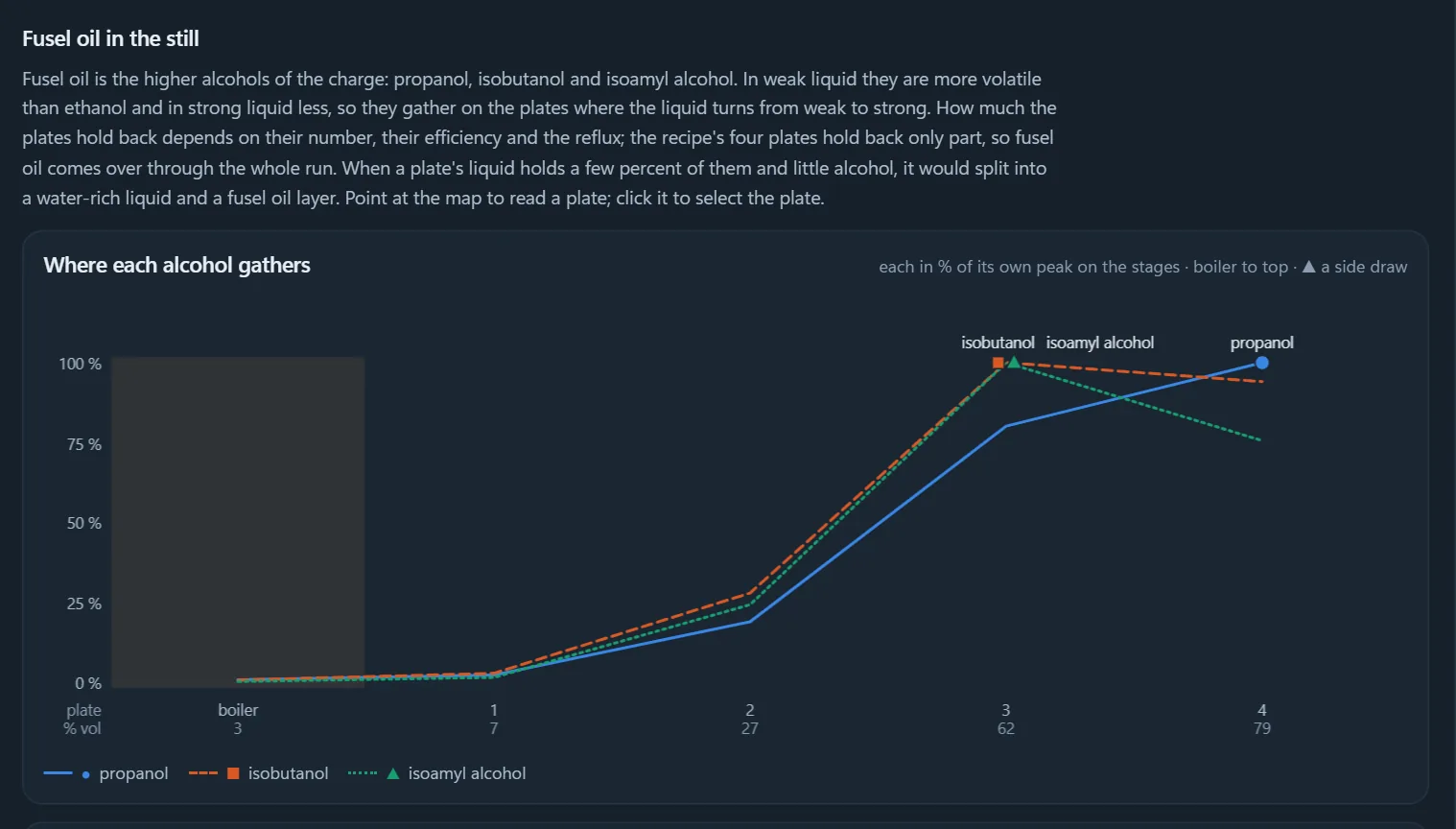
See where each fusel alcohol gathers in the column, when it comes over, what each jar holds in mg per litre, and where a plate's liquid would split into a fusel oil layer.

The Fusel oil tab: where propanol, isobutanol and isoamyl alcohol gather on the plates, and when each comes over into the jars.

Reports

Every run ends with a report you can hand over.

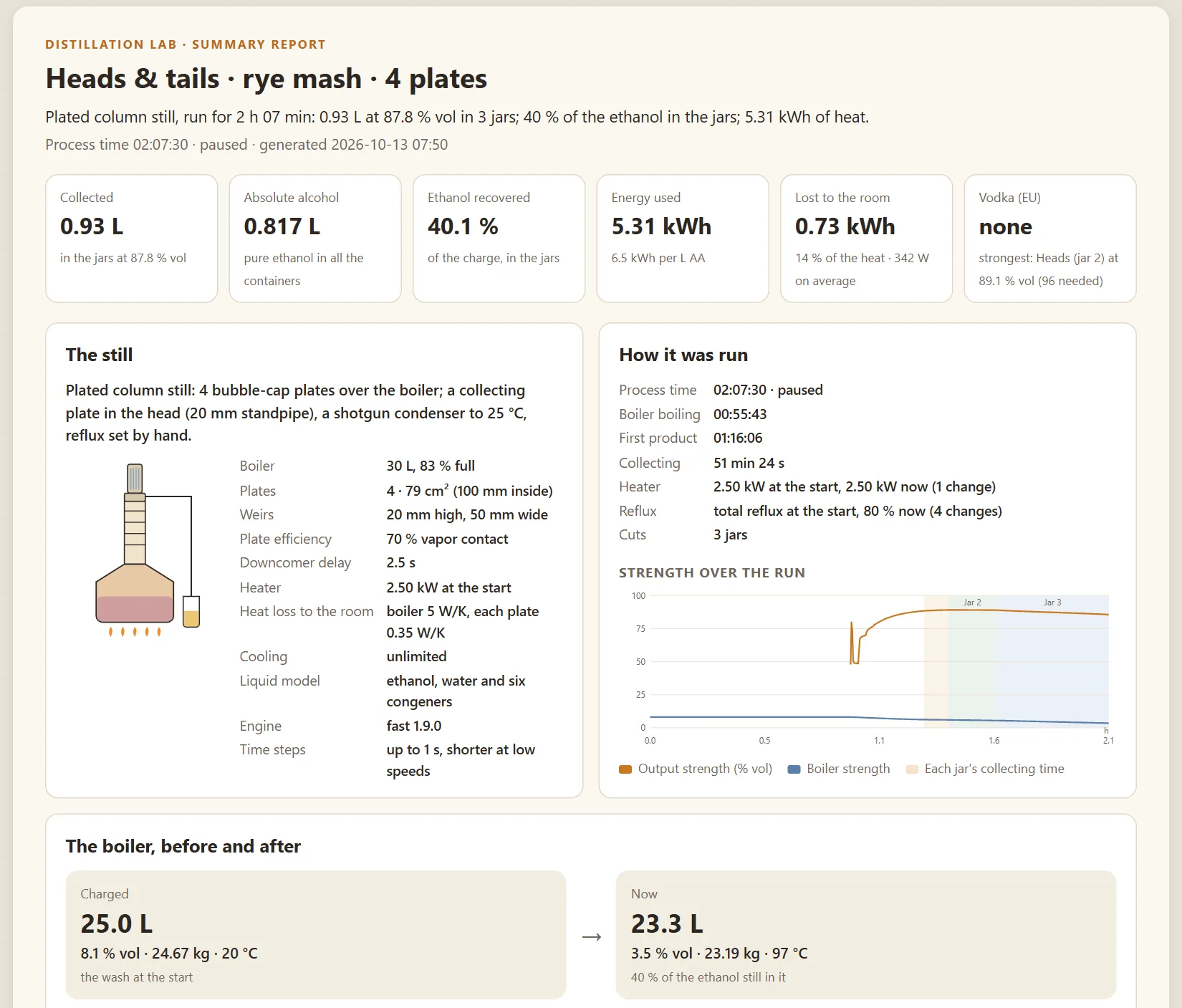
The summary report puts a run on one page: the still, how it was run, the boiler before and after, every jar with its strength, absolute alcohol and congeners, a quality guide and where the heat went. Print it or save it as a PDF.

Each jar carries its share of the energy, in kWh per litre of absolute alcohol. Download a detailed run report, CSV tables or the whole run.

A summary report: litres collected, absolute alcohol, ethanol recovered and energy used, the still with its plates and weirs, and the strength over the run.

Continuous plant

A whole continuous plant, too.

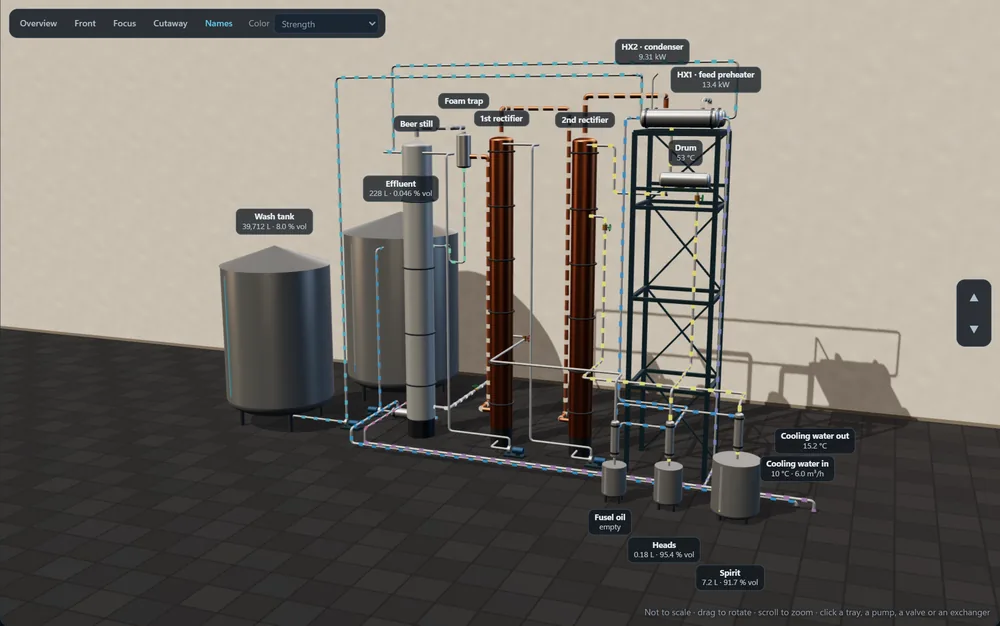
The second simulator runs a plant that never stops: the wash tank and feed pump, a beer still on live steam with its foam trap, one or two rectifiers, heads, spirit and fusel oil draws, and heat exchangers on two cooling-water lines. Add a hydroselection column, a side stripper or a fusel separator.

2D plant. The whole line as a flowsheet, here coloured by fusel oil: every tray's content beside its column, the flow of every stream and each exchanger's duty. The fusel oil draw from tray 5 runs into the fusel separator, where it splits into two liquids: the oil layer to its tank, the water layer back into the column.
3D plant. The same line in 3D: the tanks, the columns with their trays, the exchanger rack and the collecting tanks, with bands moving along every pipe that carries a flow.
Profile. Every stage of the plant from the beer still's base to the top of the last rectifier: the strength and the temperature, then each fusel alcohol and each heads compound on its own, with the fusel oil draw marked.
Columns. Each column on its own: its top tray and base, its pressures, the vapor through it, what it holds and what it feeds and draws, and its trays' strength and temperature over the run.
  • Start it cold, as a plant is started. Heat the columns through, start the feed, run the rectifiers on total reflux until they are strong, then open the spirit valve. Or let Quick start take you there.
  • Change anything while it runs. Feed rate, live steam, the draws and their trays, the cooling water: every change is kept in the run's record.
  • Heads and fusel oil here too. The same six congeners as in the still, followed through every column and into the draws (and the fusel separator, when the plant has one).

Features

Run it like a distiller.

The controls a distiller has, and a few no still has: a rewind button, a 1000× speed and balances that always add up.

  • Steer it live

    Heater and reflux sliders, a new jar whenever you cut, and side draws from any plate, all while it runs.

  • Program the cuts

    A run program takes the still through heat-up, foreshots, heads, hearts and tails by itself, each step on time, temperature, strength or volume.

  • Thermostat reflux

    A solenoid valve on the product line, worked by a sensor on any plate, with its own set point and hysteresis.

  • Rewind and branch

    Drag back to any moment and see exactly how everything was. Run on from there to try another decision.

  • Warnings that explain

    A condenser near its limit, a boiler running low, a bed close to flooding, two liquid phases: flagged on the part and listed in one place.

  • Save what you make

    Save a setup as a recipe and a jar as a product, then blend saved products with water into the next charge.

  • Metric or US

    Litres or gallons, °C or °F, % vol or US proof: one choice for every view, every report and every download.

  • Guided from the start

    Five ready recipes, from a pot still to a twelve-plate reflux column, and a guided tour of the screen in 14 steps.

The model

Built on thermodynamics you can check.

No canned animations: every number on the screen comes out of mass and energy balances and phase equilibrium, step by step.

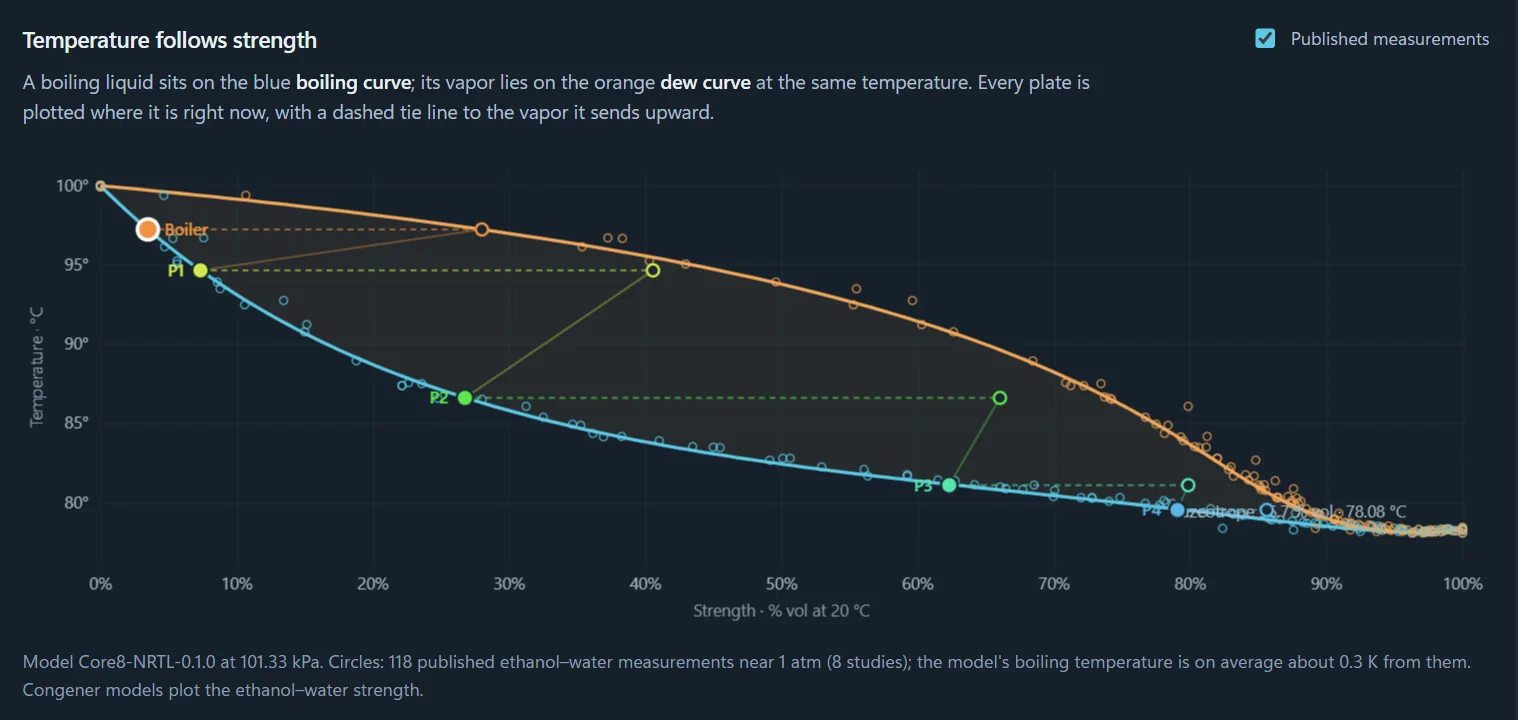
The boiling curve tab: the model's boiling and dew curves of ethanol and water, published measurements as circles, and each plate with a tie line to its vapor.
Each plate sits on the boiling curve of its own strength, here among published measurements.
Real phase equilibrium
Boiling points and vapor compositions come from an NRTL model of ethanol and water. Against 118 published measurements near 1 atm, its boiling temperature is on average about 0.3 K off.
Every gram and joule accounted for
Inventories are kept in exact integer units, so the mass and energy balances close exactly at every step, congeners included.
The hardware in the model
Each plate holds liquid up to its weir and passes it on through a downcomer, the metal has to warm up, heat is lost to the room and the condenser has a capacity. A packing's HETP follows the vapor load.
Honest about its limits
Every model names its sources, its range and its approximations. The fast engine is checked against a detailed reference model with a full phase flash: on a three-plate column they agree within 0.002 K. Whole runs have not yet been compared with runs on real stills, so treat its results as a model's estimate, not a measurement.

Who it's for

For anyone who wants to understand a still.

  • Teachers and students

    Show vapor–liquid equilibrium, reflux and plate efficiency happening live, then rewind and show it again.

  • Distillers

    See what goes on inside the column as you change the heat, the reflux and the cuts, and show new staff how a still works.

  • The curious

    Find out why a column needs reflux, where the heads go and what the thermometer at the top is really telling you.

FAQ

Questions.

What does it cost?

Nothing. Distillation Lab is free to try while it is in development: write to us and we'll send you access.

How accurate is it?

The ethanol–water boiling temperature is on average about 0.3 K from 118 published measurements near 1 atm. Plate efficiency, heat losses, metal and packing data are settings you can match to your own still. Congeners are modelled as dilute solutes with published activity-coefficient models and measured mash compositions; the documentation says where that holds and where it doesn't. How closely whole runs match real stills has not been checked yet.

Does it replace trying it on my still?

No. It is a model, made for understanding and for comparing settings, and open about its approximations. Whole runs have not yet been compared with runs on real stills, and a real still differs in efficiency, heat loss and many small details, so treat its results as an estimate, not a guarantee.

Can I model my own equipment?

Yes. Set the boiler, the number and size of the plates, their weirs and downcomers, the plate efficiency, a packing and its bed, the heater, the condenser, the head, the pressure and the heat lost to the room. Your own packings can be saved with their data.

Which congeners does it follow?

Six: methanol, acetaldehyde and ethyl acetate (the heads) and propanol, isobutanol and isoamyl alcohol (the fusel oil), in the batch still and in the continuous plant.

Which units does it use?

Metric or US customary, and the strength in % vol at 20 °C or US proof. The choice applies everywhere: the views, Setup, the reports and the downloads.

Can I save and share runs?

Save a setup as a recipe and a jar as a product, and download the scenario, a snapshot of the run, CSV tables, the summary report or the full run. A scenario file runs the same experiment again.

What do I need to run it?

A desktop or laptop with a modern web browser; the 3D views use WebGL.

Try it free.

Distillation Lab is free to try while it is in development. Write to us and we'll send you access, and we'd love to hear what you think of it.

We only use your address to send you access and news about Distillation Lab.